Country Joe McDonald - Hold on it's coming 1971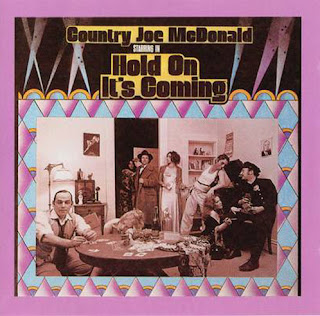
Political and ecological issues were set to musical accompaniment by Country Joe McDonald, who co-founded and led the psychedelic folk-rock band
Country Joe & the Fish, the leading left-wing band of the '60s. Since the group's breakup in 1971, McDonald has continued to musically espouse his political views through his original, folk-like songs.
A native of Washington, D.C., McDonald grew up in El Monte, CA, a suburb of Los Angeles, where his parents, Florence and Worden, had moved to escape political difficulties in the capital city. Music played an important role through McDonald's childhood, and he attended many concerts at El Monte Legion Stadium; after becoming enchanted by Dixieland music, he frequented the Lighthouse Club in Hermosa Beach.
At the age of 17, McDonald enlisted in the U.S. Navy. Following his discharge after three years, he attended City College in Los Angeles for a year. Although he moved to Berkeley to continue his schooling, McDonald was distracted by his love of music and spent most of his time playing in bands like
the Berkeley String Quartet and
the Instant Action Jug Band, which included future bandmate
Barry Melton.
Joined by folk guitarist
Blair Hardman, McDonald recorded his first tunes in 1964. Released originally by
First American Records, many of the songs were later re-recorded by McDonald for his 1976 album
The Goodbye Blues.
McDonald continued to be active in politics in the mid-'60s, and published a left-wing magazine, Rag Baby. After publishing the first few issues of the magazine, McDonald conceived the idea of recording a special "talking" issue. Released as an EP, the issue featured two songs, "I Feel Like I'm Fixing to Die Rag," a Dixieland-like indictment of the Vietnam War, and "Superbird," a satire aimed at President Lyndon Johnson; both were credited to "
Country Joe & the Fish." Following the completion of the project, McDonald and
Melton agreed to form a more serious rock band.
With McDonald's political lyrics set to a dynamic rock beat,
Country Joe & the Fish became popular in the San Francisco Bay area, performing frequently at the Jabberwocky coffeehouse in Berkeley and the Avalon and Fillmore Auditorium in San Francisco. Their second EP featured three of McDonald's tunes -- "Bass Strings," "Section 43," and "(Thing Called) Love."
Signed by Vanguard Records in December 1966,
Country Joe & the Fish soon released their first album,
Electric Music for the Mind and Body. Although "I Feel Like I'm Fixing to Die Rag" was intended to be included on the album, the record label convinced McDonald to omit it. It was finally released as the title track of the band's second album. A single of the tune reached number 32 on the Billboard charts. McDonald & the Fish made their East Coast debut at the Cafe Au Go Go in 1967. Following the release of their third album,
Together, in 1968, the band toured Europe, where they were met by enthusiastic crowds. Their fourth album,
Here We Are Again, released in 1969, featured musical guests
Jack Casady of
Jefferson Airplane and
David Getz and
Peter Albin of
Big Brother & the Holding Company.
Together with
the Fish, McDonald performed at most of the major music festivals of the '60s. Their performance at the Monterey Pop Festival in 1967 was featured in the film of the event. In addition to performing with the group at Woodstock in August 1969, McDonald performed a solo set that was capped by his obscene altering of the "Fish Cheer" intro to "I Feel Like I'm Fixin' to Die." Featured in the movie of the festival, the intro brought McDonald to international attention.
Woodstock, however, came during the final stages of the band's tenure. In the aftermath of the festival, McDonald was arrested in Worcester, MA for inciting an audience to lewd behavior, while
Melton was arrested for possession of marijuana. Although they recorded a final album,
C.J. Fish, with a new keyboard player and rhythm section, and had appeared in the 1970 film
Zacharia,
Country Joe & the Fish disbanded in 1971.
By that time, however, McDonald had signed a solo contract with
Vanguard and recorded two albums in Nashville --
Thinking of Woody Guthrie, released in December 1969, and
Tonight I'm Singing Just for You, released in May 1970. McDonald continued to tour and record as a solo singer/songwriter. During a tour of England, he recorded an album,
Hold On: It's Coming, with accompaniment by
Fleetwood Mac guitarist
Peter Green and other British musicians. In Scandinavia, McDonald was contracted by film producer
Knud Thorbjorsen to compose songs for a film based on
Henry Miller's novel Quiet Days in Clichy. The three songs he wrote -- "Mara," "Ny's Song," and "Henry Miller and the Hungry World" -- were included on the film's soundtrack. When Grove Films attempted to import copies of the film to show in United States theaters, they were seized by customs and dubbed "obscene." Grove Films eventually won a court battle, and the movie premiered in New York in 1971. McDonald later scored and appeared in a Chilean film,
Que Hacer, documenting Salvador Allende's successful campaign for president.
Beginning in April 1971, McDonald became active in the growing anti-war movement and appeared at demonstrations in San Francisco and Washington, D.C.. Together with
Jane Fonda and
Donald Sutherland, McDonald appeared during an FTA (Free the Army) tour of Vietnam that featured skits by former Second City members
Ann and
Roger Bowen. Although he became disenchanted with
Fonda's political views and left the show, the experience earned McDonald a spot on President Nixon's enemy list.
Returning to the United States, McDonald recorded an EP with the San Fransisco-based band
Grootna. A solo performance at the Bottom Line was released as a live album,
Incredible Live!, in 1972. During 1972 and 1973, McDonald performed with
the All-Star Band, a group mainly comprised of members of
the Fish and
Big Brother & the Holding Company. The band accompanied McDonald on his 1973 album
Paris Sessions.
McDonald spent most of 1974 living in Europe. Returning to California in 1975, he joined a band,
Energy Crisis, that featured former
Fish Bruce Barthol and ex-
Instant Action Jug Band member
Phil Marsh. The band appeared on McDonald's 1975 album,
Paradise with an Ocean View. The album, which included the anthemic tune "Save the Whales," reflected an increase in McDonald's ecological commitment.
The remainder of the '70s represented McDonald's most prolific period as he released seven albums --
Love Is a Fire,
Goodbye Blues,
Rock & Roll Music from the Planet Earth,
Leisure Suite,
On My Own,
Into the Fire, and
Child's Play. In 1977,
Country Joe & the Fish temporarily came together again to record an album,
Reunion.
Beginning in 1982, McDonald became involved with furthering the cause of Vietnam veterans and worked with such groups as Vietnam Veterans Against the War, Swords to Plowshares, and Vietnam Veterans of America. His experience peaked with the release of an album and video,
Vietnam Experience, in 1988.
McDonald's 1991 album,
Superstitious Blues, was a mostly acoustic effort and included two songs recorded with
Jerry Garcia of
the Grateful Dead.
Carry On, released in 1995, was inspired by the death of McDonald's parents and featured his touching tribute to Florence Nightingale, "The Lady with the Lamp," and the title track, which featured
Garcia on electric guitar. AllMusic.
listen hereFR
/
USA
/
UK
 Harry Nilsson had a hit, a Grammy, and critical success, yet he still didn't have a genuine blockbuster to his name when it came time to finally deliver a full-fledged follow-up to Nilsson Sings Newman, so he decided it was time to make that unabashed, mainstream pop/rock album. Hiring Barbra Streisand producer Richard Perry as a collaborator, Nilsson made a streamlined, slightly domesticated, unashamed set of mature pop/rock, with a slight twist. This is an album, after all, that begins by pining for the reckless days of youth, then segues into a snapshot of suburban disconnectedness before winding through a salute to and covers of old R&B tunes ("Early in the Morning" and "Let the Good Times Roll," respectively), druggie humor ("Coconut"), and surging hard rock ("Jump Into the Fire"). There are certainly hints of the Nilsson of old, particularly in his fondness for Tin Pan Alley and McCartney melodicism -- as well as his impish wit -- yet he hadn't made a record as cohesive as this since his first time out, nor had he ever made something as shiny and appealing as this. It may be more accessible than before, yet it's anchored by his mischievous humor and wonderful idiosyncrasies. Chances are that those lured in by the grandly melodramatic "Without You" will not be prepared for either the subtle charms of "The Moonbeam Song" or the off-kilter sensibility that makes even his breeziest pop slightly strange. In short, it's a near-perfect summary of everything Nilsson could do; he could be craftier and stranger, but never did he achieve the perfect balance as he did here. AllMusic.
 / USA
/ USA / UK
/ UK


 /
/  /
/ 


 /
/  /
/ 

 /
/  /
/ 

 /
/  /
/ 

 /
/  /
/