Rock has had very few star violinists, mostly because the violin isn't usually regarded as a rock instrument --
David Cross of
King Crimson,
Darryl Way of
Curved Air, and
John Weider of
Eric Burdon & the Animals come to mind, and that's about it. Except for
Jerry Goodman, the only American in the bunch and arguably the best known of the bunch, thanks to the amount of airplay received by his most successful group recordings.
Goodman was born and raised in Chicago and took up the violin as a boy. He was classically trained and had the dexterity for a career in classical but not the dedication to the field -- trained in classical technique and repertory, he found the music unfulfilling, and initially ended up on the periphery of music, working as a roadie for a Chicago-based outfit called
the Flock, who had lately changed their name from the Exclusives and were making some noise locally on a local label.
Goodman's joining the group brought a vast new range of color to their sound, concurrent with the rock-jazz fusion boom -- a contract with Columbia Records followed, and their self-titled first album followed. An immediate cult favorite,
The Flock was the first large-scale showcase for
Goodman's playing. The group was soon accepted as a junior member of rock's new elite, playing festivals alongside the likes of
Jimi Hendrix,
Led Zeppelin,
the Grateful Dead,
Jefferson Airplane, and
Janis Joplin, even making it into the European rock festival documentary Stamping Ground.
Goodman's tenure with the group ended in 1970, and he retreated from the music business, withdrawing to rural Wisconsin.
He was still there when
John McLaughlin came calling in early 1971, in search of a violinist. His first choice was
Jean-Luc Ponty, but
Ponty wasn't an American and there were potential problems with his immigration status.
The Flock led
McLaughlin to
Goodman, and
Goodman, in turn, to participate in recording
McLaughlin's solo album
My Goal's Beyond. That recording, in turn, led to
Goodman's becoming a member of the original
Mahavishnu Orchestra, where his playing truly moved into the spotlight, even sharing it with
McLaughlin and keyboard player
Jan Hammer. Across three LPs,
The Inner Mounting Flame,
Birds of Fire, and
Between Nothingness and Eternity,
Goodman achieved an international following with his mixture of folk, rock, classical, and jazz influences, all played in a manner coupling assertiveness and lyricism. The group only lasted until 1973, when it broke up amid much acrimony, leaving sessions for an unissued studio LP behind (The Trident Sessions) which saw release more than two decades later.
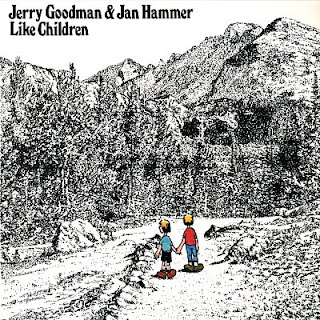
Goodman and
Hammer turned around and, for the Nemperor label, recorded the album
Like Children.
Goodman wasn't heard on record for another decade. He re-emerged in the mid-'80s on the new age-oriented Private Music label, with
On the Future of Aviation and
Ariel. The first album was a major surprise, featuring very little violin, while the second LP was more in a string-focused mode.
Goodman in more recent years has also worked in film music, in Dirty Rotten Scoundrels (1988), The Truth About Cats and Dogs and Waiting for Guffman (both 1996), and Best in Show (2000). He has also been a member of the reformed
Dixie Dregs -- a fusion group heavily influenced by
the Mahavishnu Orchestra -- since the 1990s.
To pop music fans, keyboardist
Jan Hammer is best known for his work on the soundtrack of the stylish '80s cop series Miami Vice. But
Hammer also achieved considerable success in the jazz fusion world, both on his own and as a charter member of
John McLaughlin's legendary
Mahavishnu Orchestra. Though jazz purists often decry major portions of his solo work,
Hammer has undeniably left his mark, both musically and commercially.
A native of Prague, in what was then Czechoslovakia,
Hammer was born into a musical family (on April 17, 1948) and began studying piano at age four. By age 14, he was working with a touring and recording jazz ensemble that also included future
Weather Report member
Miroslav Vitous.
Hammer studied theory and composition at the Prague Academy of Muse Arts, but when the Soviet Union invaded Czechoslovakia in 1968, he emigrated to the U.S. After attending the Berklee School of Music, he landed a year-long touring engagement with
Sarah Vaughan as both keyboardist and conductor. In 1970,
Hammer settled in Manhattan and recorded as a sideman with
Elvin Jones and
Jeremy Steig. The following year, he joined
the Mahavishnu Orchestra, appearing on landmark fusion albums like
The Inner Mounting Flame and
Birds of Fire. After the group disbanded at the end of 1973,
Hammer reunited with
Mahavishnu violinist
Jerry Goodman for the album
Like Children (1974).
Hammer released The First Seven Days himself in 1975, and he assembled a backing unit called the Jan Hammer Group for the supporting tour. The Hammer Group recorded prolifically over the next two years, including collaborations with guitarist
Jeff Beck, and their brand of fusion shifted towards R&B-styled grooves. After 1978's
Melodies,
Hammer disbanded the group and recorded a true solo album,
Black Sheep, playing all the instruments himself. In short order, though, he formed another backing band, this one called simply
Hammer.
The early '80s found
Hammer working with, among others,
Al DiMeola (Electric Rendezvous) and
Journey guitarist
Neal Schon (
Untold Passions and
Here to Stay), as well as supporting
Jeff Beck in the studio.
Hammer was becoming increasingly involved in pop/rock session collaborations, and by 1984, he had already moved into composition for television and film as well, debuting as a soundtrack composer with the film A Night in Heaven. His big break in this arena came when the producers of a new MTV-style police series called Miami Vice tapped him as weekly score composer. When a soundtrack album was released in 1985, including several
Hammer compositions as well as rock songs featured in the series,
Hammer's driving opening theme music hit number one on the pop singles charts, the first TV theme to do so since 1976. The album was a worldwide success, and "Miami Vice Theme" won
Hammer two Grammys (Best Pop Instrumental Performance and Best Instrumental Composition).
Hammer remained involved with Miami Vice until 1988, when he retired to upstate New York to construct a home studio and return to solo recording. The first result was
Snapshots, issued in 1989, another true solo album on which
Hammer performed every note himself. Subsequently,
Hammer rededicated himself to soundtrack composition, including 1992's acclaimed computer-animation project
Beyond the Mind's Eye. 1994's
Drive became
Hammer's first non-soundtrack recording in five years; for the remainder of the decade,
Hammer continued his profitable work for TV, film, commercials, and even video games.
Keyboardist and violinist
Jerry Goodman away from
Mahavishnu. They play all instruments (overdubbed). "Country and Eastern Music" and "Steppings Tones" were high-water marks for this new breed (at the time). AMG.
listen here
 One could easily make the case for designating the Master's Apprentices as the best Australian rock band of the '60s. Featuring singer Jim Keays and songwriter/rhythm guitarist Mick Bower, the band's earliest recordings combined the gritty R&B/rock of Brits like the Pretty Things with the minor-key melodies of the Yardbirds. The compelling "Wars or Hands of Time" and the dreamy psychedelia of "Living in a Child's Dream" were undiscovered classics, although the latter was a Top Ten hit in Australia. Bower left the group after suffering a nervous breakdown in late 1967, and the Masters grew steadily less interesting, moving from flower pop and hard rock to progressive and acoustic sounds. Plagued by instability (undergoing eight personnel changes between 1966 and 1968), the group moved to England in the early '70s, achieving some cult success with progressive rock albums before breaking up in 1972. AMG.